


Don’t bother asking an LLM like OpenAI or even Grok if illegal aliens receive SNAP benefits. They will insist that they don’t because federal law prohibits them from receiving SNAP. That is like saying people do not speed because the speed limit prohibits them from speeding. So let’s get into the facts that AI won’t tell you. The most frequently cited statistic about the Supplemental Nutrition Assistance Program, or SNAP, is that about 43 million Americans rely on it each month to feed themselves and their families. That number is often used to justify the program’s scale and reach. But this monthly average hides a far more disturbing truth. Because of high turnover, the real number of Americans who receive SNAP benefits at some point during a given year is much higher. Federal data show that 52% of new enrollees leave within one year, and 67% within two years. That means that across twelve months, between 63 and 83 million unique individuals participate in the program. In other words, about 22% of the entire US population uses SNAP to buy food during any calendar year. This is not a small anti-poverty program. It is a vast, parallel food economy. The only way such numbers make sense is if many more illegal immigrants are benefiting from the system than politicians admit.
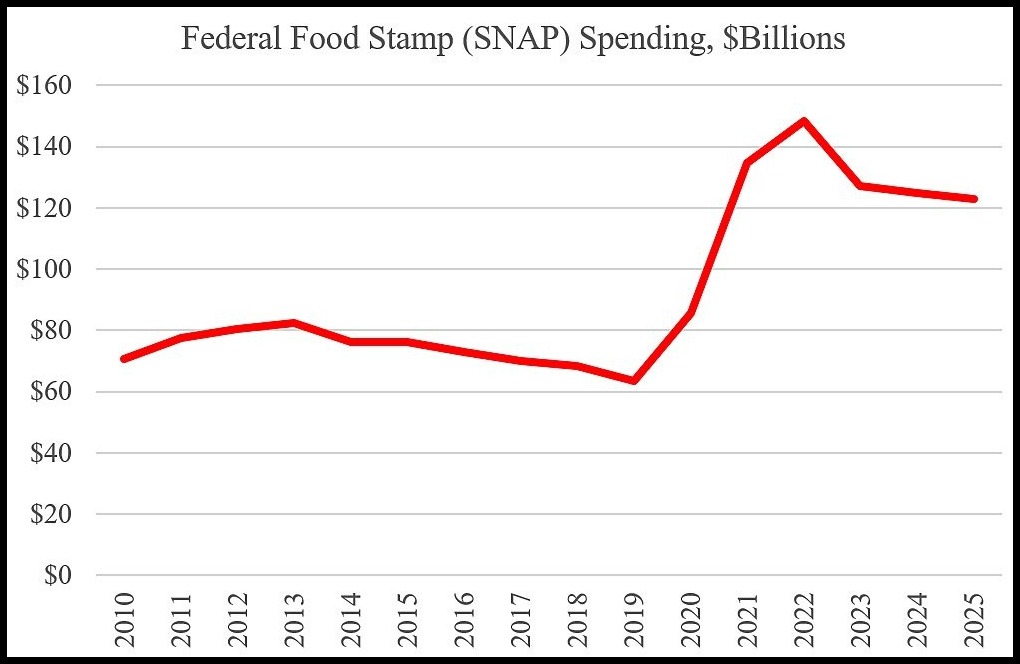
The government estimates that SNAP serves about 16 million households monthly, which extrapolates to 24 to 32 million unique households annually. That means nearly one in four households participates each year. Among them, about 20 million people remain permanently dependent on the program, locked into a system that punishes work and rewards continued reliance. The result is a welfare trap, an underclass of Americans who live in quiet misery, unable to risk a job or a raise for fear of losing their benefits. They are not lazy; they are rational. The system teaches them that effort costs more than idleness, and Democrats exploit this reality by convincing these citizens that they cannot live without government assistance. In exchange for votes, they promise endless benefits, cementing a cycle of dependency that keeps people poor and keeps Democrats in power.
This expanding dependency has been thrown into sharp relief by the ongoing government shutdown. SNAP benefits are set to be suspended on November 1 if the shutdown persists, and states like California, Illinois, Maine, Massachusetts, Minnesota, and Washington have each announced that their food programs for illegal immigrants will be suspended at the same time. These programs were supposedly distinct from SNAP, yet their funding halts when SNAP halts. That coincidence exposes the truth: the money, the systems, and the administrative pipelines are connected. States have long played a shell game, quietly routing federal funds into state-level programs for illegal immigrants. The shutdown has revealed the link.
The implications are enormous. If SNAP were truly separate from these state programs, the shutdown would inconvenience them, not paralyze them. Their paralysis proves a shared infrastructure, shared databases, shared eligibility systems, and, most troublingly, shared funding streams. This confirms what conservatives have long argued: state officials are using federal welfare mechanisms to subsidize benefits for illegal immigrants. It is not a clean firewall between programs. It is a revolving door.
To understand how this is possible, one must look at how SNAP defines a “household.” The program calculates benefits not for individuals, but for everyone who “purchases and prepares food together.” That definition means that a single eligible person can declare multiple co-residents as part of their household, even if those co-residents are illegal immigrants. Federal law prohibits states from demanding Social Security numbers from ineligible members as a condition of another member’s application. Nor may they verify immigration status except for those claiming direct eligibility. As long as the primary applicant qualifies, benefits can be increased for every claimed household member. There is no statutory limit on how many people can be listed. Enforcement of fraud penalties is weak, and verification checks are rare, especially in blue states that pride themselves on “inclusive” welfare policies.
In Republican-controlled states, caseworkers often verify claims and investigate suspicious households. In Democrat states like California, by contrast, oversight is practically nonexistent. Administrators are discouraged from probing too deeply into the composition of households for fear of being accused of discrimination or creating a “chilling effect” on mixed-status families. This honor system, combined with a debit card distribution model, invites abuse. When an ineligible adult lives in a household receiving SNAP, the groceries purchased feed everyone, including those barred by law from receiving federal benefits.
The shutdown is revealing more than administrative weakness. It is exposing the moral failure of a system that confuses compassion with dependency. Politicians on the left defend SNAP as an essential lifeline for the poor. That much is true. But it has also become a magnet for fraud and a mechanism of quiet population support for illegal immigrants. SNAP’s structure ensures that benefits flow to households, not individuals, making enforcement almost impossible without political will. Even those who want to leave the program find it punishes self-improvement. Because SNAP reduces benefits by roughly 30 cents for every dollar earned, and because those losses stack with other welfare phaseouts and taxes, the effective marginal tax rate for a low-income worker can exceed 40% or even 50%. Work harder, earn less. The result is predictable. Millions of Americans, perhaps 20 million, stay in the system permanently, conditioned to believe the only way to increase their income is not by working harder but by having another child or inviting another ‘friend’ to join their household, which raises the benefit level. The welfare structure quietly trains dependency as a survival strategy rather than rewarding independence.
This long-term dependency has created what can only be described as a lifestyle class, a group trapped not by vice but by arithmetic. They are victims of a structure that makes work irrational and effort futile. Each month they swipe their EBT cards and hope the next Congress does not cut their benefits. As the shutdown looms and payments stop, many of these hardened dependents have taken to TikTok, recording thousands of videos about their anxiety and panic. Their stories are not of hardship but of dependency, showing how thoroughly the system has conditioned them to see the government as provider. They are told the system is there to help them, but it has quietly made them wards of the state.
That is why the current shutdown matters. When SNAP stops, so do the state programs serving illegal immigrants.

Some convict in prison eat better then the average American and so the Dem-O-Rats are going to let the rest of us starve while feeding their future voters and supporters?!
The EXPLOSION of spending coincides with the 20 MILLION or so ILLEGALS that the biden bunglers let in! That and the covid crap added a lot, but you KNOW a LARGE portion has to be the ILLEGALS!