

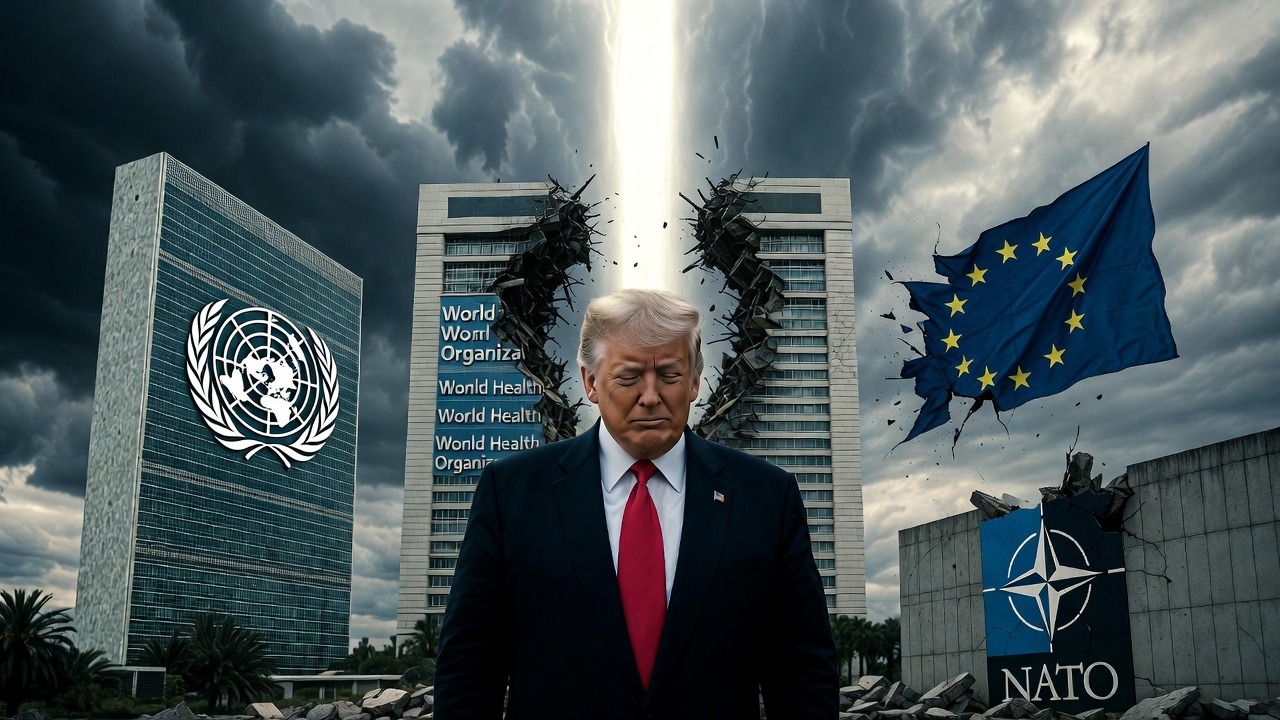
The week’s biggest story was something even more astonishing, encouraging, and revolutionary than any turnaround in two-tiered justice. For some of us, for our entire lives, the big international institutions were just an accepted norm, the way things were, like the sea monsters drawn at the map’s edge. They were things to be avoided, and things to try not thinking about too much. I refer to NATO, the European Union, the World Economic Forum, the United Nations, and the World Health Organization. But —just one year into Trump 2.0— every single one of these seemingly immortal institutions now teeters on the brink of disaster.
Consider this random tweet, like a death-rattling canary in the geopolitical coal mine, from last week:

Opinions, like methane emitters, are common— and they all stink. But think about the global conditions that make such an opinion possible, and consider that nobody’s laughing about it. Here’s one more example picked at random, just to make the point:

The tone of these comments sounds almost as though the authors were stating something self-evident; something perhaps even uncontroversial. How did we get here so fast?
🔥 While conservatives have long chafed about the expense to U.S. taxpayers of supporting these “vital international institutions,” it wasn’t until the pandemic that most people became aware of how much influence they wielded over our personal lives and undermined our individual freedoms, as opposed to just being vague, distant bureaucracies composed mostly of irrelevant foreigners who busied themselves in other parts of the world and largely left us alone.
Then came covid.
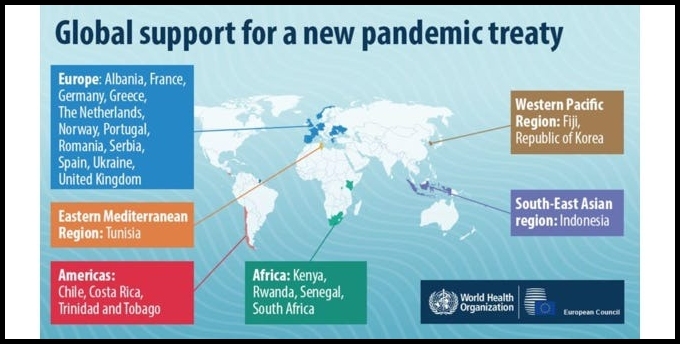
The World Health Organization emerged as a biomedical dictator, with Democrats enshrining every random WHO decree into local law and even trying to sign us up to a global treaty to give the WHO direct power over individual Americans during declared “health emergencies.” We saw the World Economic Forum go all out to leverage the pandemic into a technocratic “Great Reset”— a Marxist ‘utopia’ of 15-minute cities, cockroaches-for-food, bans on livestock, sun-darkening chemtrails, and propertyless existences of owning nothing and being mandated to happiness. Smile! Or else!
Meanwhile, NATO and the EU, long criticized as feckless and wasteful but largely dismissed by ordinary Americans as other people’s problems, hove into view as having outsized influence on America’s elites and our political classes. We watched as trillions of U.S. taxpayer dollars were ritualistically burned to please our European comrades, ostensibly to fund an endless war in Ukraine that involved zero American interests —an unwinnable boondoggle rife with billion-scale corruption— while back at home, our own country sagged under the excruciating hardships of the pandemic.
We learned that, not only did these international institutions drool over the prospect of imposing personal vaccine mandates and travel limits on us, but they were using our own money to do conquer us. In other words, the UN, NATO, EU, WEF, WHO were revealed to many Americans as sworn enemies pretending to be biomedical technocrats, who could never hope to trouble us in the least without us first helping them do it, aided by a major captive political party which shall remain nameless (until I name it again).
🔥 I’ll offer a few quick examples as evidence, then I’ll inventory how much things have changed in a year. First up, consider this remarkable clip of German Chancellor Friedrich Merz musing that the EU didn’t lose to America or China— it lost to bureaucracy. Bloomberg ran the story below the awkward headline, “Merz Calls for European Unity to Defend Against Power Politics.”
🚨🇩🇪🇪🇺 GERMAN CHANCELLOR: EUROPE DIDN’T LOSE TO CHINA OR AMERICA. IT LOST TO FORMS AND PERMITS
Merz just said it plainly (and refreshingly honest):
Germany and the EU kneecapped their own growth with endless rules, delayed reforms, and a reflex to regulate first and think… https://t.co/YPgq2A7t0Z pic.twitter.com/hJLlZGIwuW
— Mario Nawfal (@MarioNawfal) January 22, 2026
But Merz didn’t so much dwell on EU unity. Unity was the problem. “Germany and Europe have wasted incredible potential for growth in recent years by dragging feet on reforms and unnecessarily and obsessively curtailing entrepreneurial freedoms and personal responsibility,” Merz assured the WEF. “We must reduce bureaucracy substantially in Europe. We have become the world champion of over-regulation.” He added that the idealized “common market” had devolved into a “museum of forms, permits, and compliance departments.”
He almost sounded like President Trump.
It might not seem like it, but this brief anti-bureaucratic invective was a declaration of civil war. Germany is Europe’s economic heart. The Germans prize industry and efficiency, whereas most other Western European countries focus on maximizing their vacation months and reducing the many untold burdens of the 30-hour work week. In other words, without Germany, there is no European Union.
What regulations were the Chancellor complaining about? How much time do you have? European Union regulations focus on climate change, health policy, privacy, transportation, financial services, labor rights, immigration, lemonade stands, daydreams— you name it. If it exists, the EU has tried to regulate it.
If Merz is serious, Germany is saying it isn’t going to take it anymore. It is tired of closing major automotive plants while the US runs ours 24×7. If a globalist like Merz is pushing entrepreneurial freedom, you know things must be bad. If even Merz is denouncing bureaucracy —a progressive synonym for “democracy”— they’ve reached a crisis point.
That’s just an example. Over-regulation is not even close to the only issue fracturing the EU. Ukraine, Greenland, US tariffs, conflicts between Western and Eastern Europe, a chronic stagnating economy— it is all coalescing into a crisis that the EU may not long survive.
One year ago, the European Union was being held up as a shining example of multilateralism in vibrant action.
🔥 Next, yesterday the New York Times glumly reported that, “ U.S. Formally Withdraws From World Health Organization.” It was another delightful development that President Trump launched early last year on his first day in office, but which flowered into beautiful bloom this month.
What would we do without fretful experts? The story’s subheadline moaned, “Global health experts worry that a lack of international coordination will lead to death and disaster.” Poor babies. No more WHO gravy train. No more swanking at international health conferences in Switzerland. No more being feted as global power players.
Nobody is even listening to them worry, this time. “All U.S. government funding to the organization has been terminated,” the Times said, “and all assigned federal employees and contractors have been recalled from WHO’s Geneva headquarters and its offices worldwide.”
WHO defenders defiantly vowed that the authoritarian health behemoth headquartered in Geneva will survive just fine without the US. Haha, that reminds us of PBS’s brave declarations. But other articles noted that the WHO was already downsizing its staff and programs, having been preparing for the loss of U.S. funding after Trump’s January, 2025, executive order.
Will China, the EU, and the Gates Foundation continue funding the WHO once it no longer holds sway over American policy? If so, they’ll have to pay a lot more for a lot less. An even more important question is, what happens to the WHO’s reach and effect without America’s participation? One suspects that the Trump Administration will remain antagonistic to the vast health bureaucracy, and like the EU, the writing may be appearing on the wall.
In any case— in just a year, the WHO went from standing on the brink of controlling the entire world’s day-to-day health policies to struggling to toppling on the cliff of destruction.
As terrific as that news is, we’ve left the biggest and best one for last.
🔥 The United Nations was formed from the furnace of World War II. Although its mission has crept far and wide, its core charter remains the same. From Article I, Section 1 of the UN Charter: “To maintain international peace and security, including taking effective collective measures against threats to peace, suppressing aggression, and settling disputes peacefully in accordance with justice and international law.”
That sounds nice, doesn’t it? But last week, world globalists suddenly became terrified that Trump is busily replacing the United Nations. Let’s survey the many headlines, beginning with CNN, two days ago:

That was one of the tamer ones. Reuters, this morning:

From the Associated Press, two days ago:

It began innocently enough. You may recall that, after President Trump negotiated his peace deal between Israel and Hamas, one of the 28 points included the creation of a “Board of Peace” to oversee the reconstruction of Gaza. Trump was to be its chairman.
But last week, while President Trump lobbied for countries to join his new Gaza Board of Peace, critics immediately noticed that the “Gaza” part of the name had been dropped, and it was just “the Board of Peace” now. And, its written charter was much broader than merely “Gaza reconstruction.” The charter didn’t even really mention Gaza at all. Instead, it described a global role to “promote stability, restore dependable and lawful governance, and secure enduring peace in areas affected or threatened by conflict.”
Gosh, that sounded just like the UN’s charter. And folks noticed. Hence, all the anguished headlines about rivaling (best case) or replacing the UN (womp, womp).
Even worse, the BOP’s preamble spoke critically of “approaches and institutions that have too often failed” —cough, the United Nations— and called for a “more nimble and effective international peace-building body.” More nimble than which international peace-building body?
Then, in interviews, Trump himself suggested the BOP “might” supplant the UN— in certain functions. You never know. Senior U.S. officials were even more blunt. They told media that the BOP “is not going to be limited to Gaza. It’s a Board of Peace around the world.”
If a worldwide Board of Peace is handling the UN’s own chartered responsibilities, then what do we need the UN for?
🔥 It happened in a flash, before they even knew what hit them. The elites must have felt like they were being attacked in a dark closet. Yesterday, Trump held a signing ceremony —ironically, at the World Economic Forum— and launched his International BOP with a few dozen initial members. (Hilariously, Canada tried to join, but Trump officially rescinded its invitation after Prime Minister Carney’s cartoonish WEF speech comparing the US to a bullying grasshopper.)
Haha! And the President smuggled in the whole thing, right under their noses, via the Gaza Peace Deal. Now it’s off and running, too late for UN votes or condemnations, leaving the globalists scurrying to try to catch and kill it before its athletic abilities develop any further.
Consider how brilliant and audacious this strategy was. Trump isn’t bothering to reform the UN. He’s not even pulling the US out of the main body, where we need to stay on the Security Council to make sure nothing goes sideways. (And it’s easier to kill the UN from inside anyway.)
Instead, Trump said, “I’ll just make a new United Nations.”
🔥 The implications are staggering. Trump stands poised to kill the UN softly. For just one example, imagine if the US, from its position on the Security Council, simply vetoes all ‘peacekeeping’ missions unless they are routed through his new Board of Peace. The argument makes itself— UN peacekeeping missions usually fail, the UN is too often deadlocked in voting paralysis, and it is fantastically expensive compared to what it actually accomplishes. So, the argument would go, let’s give the job to someone who knows how to broker peace efficiently.
Someone like President Trump! After all, he just ended eight wars —the Gaza ceasefire, DRC-Rwanda, Armenia-Azerbaijan, India-Pakistan, etc.— in one year.
Think about it. Trump’s peacemaking deals last year now look more like strategic preplanning— a ‘proof of concept’ justifying a UN replacement, not merely ‘lobbying for a Nobel prize.’ Everybody bought the idea that Trump actually cared about the stupid Nobel prize, and it was just a head fake the whole time.
Now cast your mind back to Trump’s last speech at the UN in September. He told the General Assembly how he’d made more peace in one year than they had in forty. He lambasted the UN for offering “little help,” and asked rhetorically, “What is the purpose of the United Nations?”
He was setting it all up.
The evidence isn’t just the Board of Peace and Trump’s speech. Remember how, on January 7th, Trump signed a presidential memo withdrawing the U.S. from 66 international organizations, conventions, and treaties deemed “contrary to U.S. interests?” They included 31 UN-affiliated entities (e.g., UN Population Fund, UN Framework Convention on Climate Change) and 35 non-UN multilateral bodies (e.g., Intergovernmental Panel on Climate Change—IPCC, Inter-American Institute for Global Change Research). Boom.
Meanwhile, President Trump’s adversaries lie docile and powerless —unable to even effectively complain (see, e.g., Mark Carney)— cowering like toads ‘neath the harrow, in perpetual fear of the ever-present threat posed by the tariff dashboard’s glittering deterrance.
Their love of money renders them impotent.
🔥 All of these examples are terrific news in their own right. But take them together. Look at the big picture. Trump isn’t just draining the Swamp. He isn’t just remaking American government agencies. He’s tearing down the whole international order, and all its historic agencies too. The WHO, WEF, EU, NATO, and the UN are all now in play.
Can you see it yet? Trump’s careful year of preparation has transitioned into the year of action. Not just in America; the entire world is shifting like it’s been struck by the earthquake that sank the mythical City of Atlantis. I’m not sure it’s any exaggeration to say Trump has built a new American empire in twelve months.
No one saw the full architecture falling into place, because no one imagined it could be built this fast. They probably thought it impossible.
As a result, they never saw the hyper-train coming before it hit them. Their imaginations weren’t big enough. While Trump built his tariff dashboard, the experts laughed merrily, heckling it as a failed tax-collection tool, doomed to collapse in inflationary disaster. But they entirely missed the point.
Trump wasn’t building some ego-based revenue gimmick; he was building a geopolitical net in which to catch the entire world. Now every country, big and small, are fish wriggling in Trump’s net.
This new American empire is not the empire of Wilson, Roosevelt, or Reagan. It’s something far older in spirit —more like the Roman or British empires at their peak— but executed with 21st-century tools: real-time economic dashboards, invitation-only clubs, and unilateral presidential authority via a de facto Trump veto on everything.
And behind the velvet glove of the tariff dashboard lies an iron fist. Mere weeks ago in Caracas, Trump showed the world America’s steely resolve. Make too much trouble, and you’ll find yourself in maximum security by breakfast (dry toast and water). Maduro had his chance, but he defied the softer tariff threats— and see what happened? Crunch.
Oh— one more thing. The Board of Peace’s charter, ratified yesterday at Davos, makes Trump chairman for life— a role that will survive the end of his presidency in January 2029. Just saying.
