

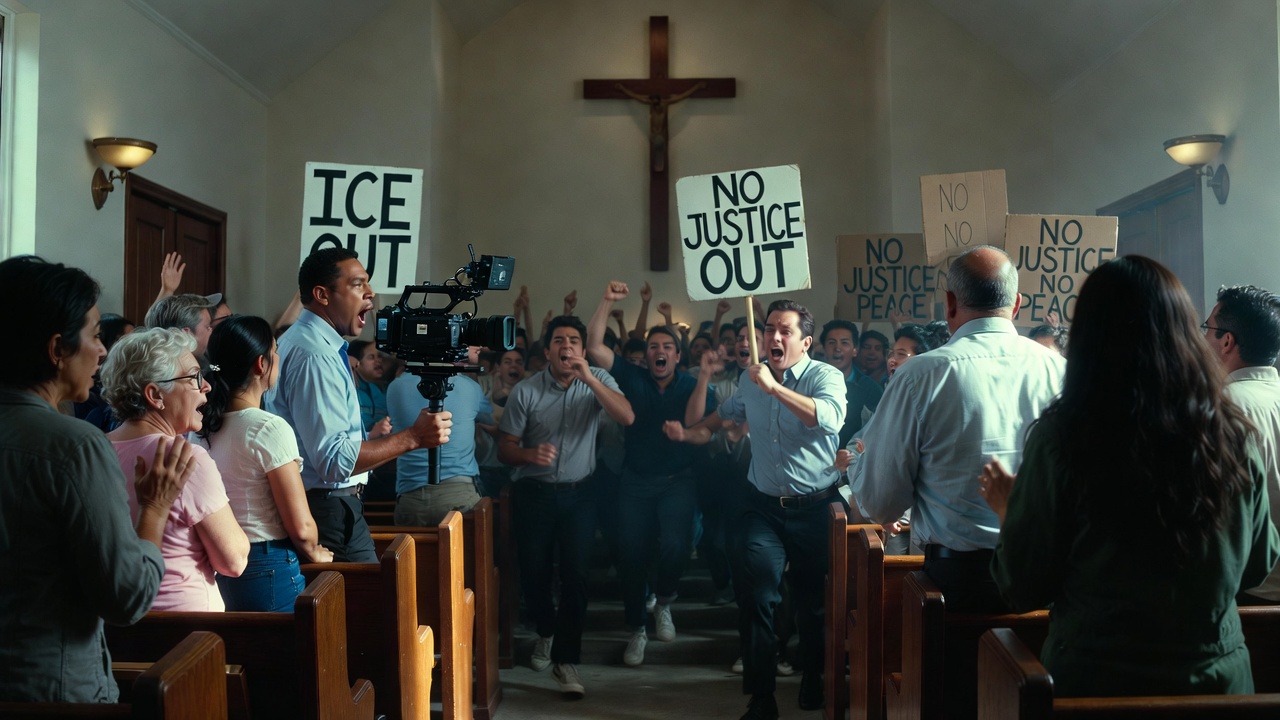
On January 29, former CNN host Don Lemon was arrested for joining anti-ICE rioters who had invaded Cities Church services in St. Paul, Minnesota, eleven days earlier. Terrifying the attendees, these activists sought to condemn the pastor’s alleged ICE connection after the death of Renee Good.
At this point, it is important to recognize that there is a difference between a “protest” and a “riot.” Perhaps international security firm TAL Global provides the simplest distinction between the two. It notes, “The difference between protest and a riot often comes down to intent and control. Protest maintains a message. Riots spiral away from one.”
In other words, what starts out as a peaceful protest at some point may well cross a line, transitioning into a riot as it becomes violent or violates the law.
In the aftermath of the Cities Church incident, Lemon—while examining a video of it—insisted on describing anti-ICE activists with whom he was embedded as “protesters.” This was despite the fact that they had already stepped over a distinctive line by storming onto private property where a religious service was ongoing, chanting “Hands up, don’t shoot” and “ICE out.” Church attendees had every right to be where they were and doing what they were doing without having their religious service interrupted by protesters (now rioters) gone bad.
Among the first celebrities to criticize Lemon was Grammy-winner Nicki Minaj, who did so in language that was both explicit and unapologetic. Many saw the church occupation not as an act of journalism but as an act of harassment against Christians. Lemon and his friends dared not attempt a similar invasion at a mosque holding religious services, as a much different reception would have awaited them.
Lemon went on to support the rioters, defending their actions in disrupting church services as this was just acting in a manner similar to what civil rights protesters had done decades earlier. He continued, further demonstrating his “independent” journalistic reporting, by saying:
This is the beginning of what’s going to happen here. When you violate people’s due process, when you pull people off the street, you start dragging them and hurting them, and not abiding by the constitution, you start doing all of that, people get upset and angry. Remember what the civil rights movement was about. The civil rights movement was about these very kinds of protests.
Lemon—obviously no expert on constitutional law—claimed people had no right to object to protests like the one in Cities Church as the U.S. Constitution allows for them at any time. “The whole point of it,” he added, “is to disrupt and make people uncomfortable.” But the naive journalist failed to recognize that the Constitution was inapplicable to the Cities Church invasion and that he and his fellow rioters violated the law.
Apparently, making no effort to master the Constitution, Lemon misses an important aspect of it. The First Amendment prohibits the government from restricting speech and recognizes that people have the right to engage in religious practices as they wish without interruption. Defenders of ICE would have no right to demonstrate on Lemon’s private property, just like he and his anti-ICE gang had no right to demonstrate on private church property.
Fellow members of the media sought to portray Lemon as an “independent” member of the media who was simply following a developing story. Such independence was hard to grasp as Lemon used the pronoun “we” in referencing the group’s invasion and even dubbed it “our operation.”
Had the developing story involved activists enroute to robbing a bank, would Lemon have had a right to enter its premises with them just to follow the story? Absolutely not! When subjects of a developing story show they are willing to break the law—in the Cities Church case, at a minimum, they trespassed—it gives a journalist no right to break the law as well. A long-embraced ethic of journalism is for journalists to report a story but never to become part of it in doing so.
As a newsman, Lemon should have recognized the illegality of his actions based on an incident occurring just two days earlier in Manhattan. Following 45 minutes of forewarnings, the NYPD arrested anti-ICE protesters after they entered a hotel and occupied the lobby. Like Lemon, they illegally trespassed onto private property.
However, Lemon’s actions went further: he’s also being charged with conspiracy to deprive parishioners of their rights and for violation of the Freedom of Access to Clinic Entrances (FACE Act). Despite its title, the FACE Act additionally protects places of religious worship.
