

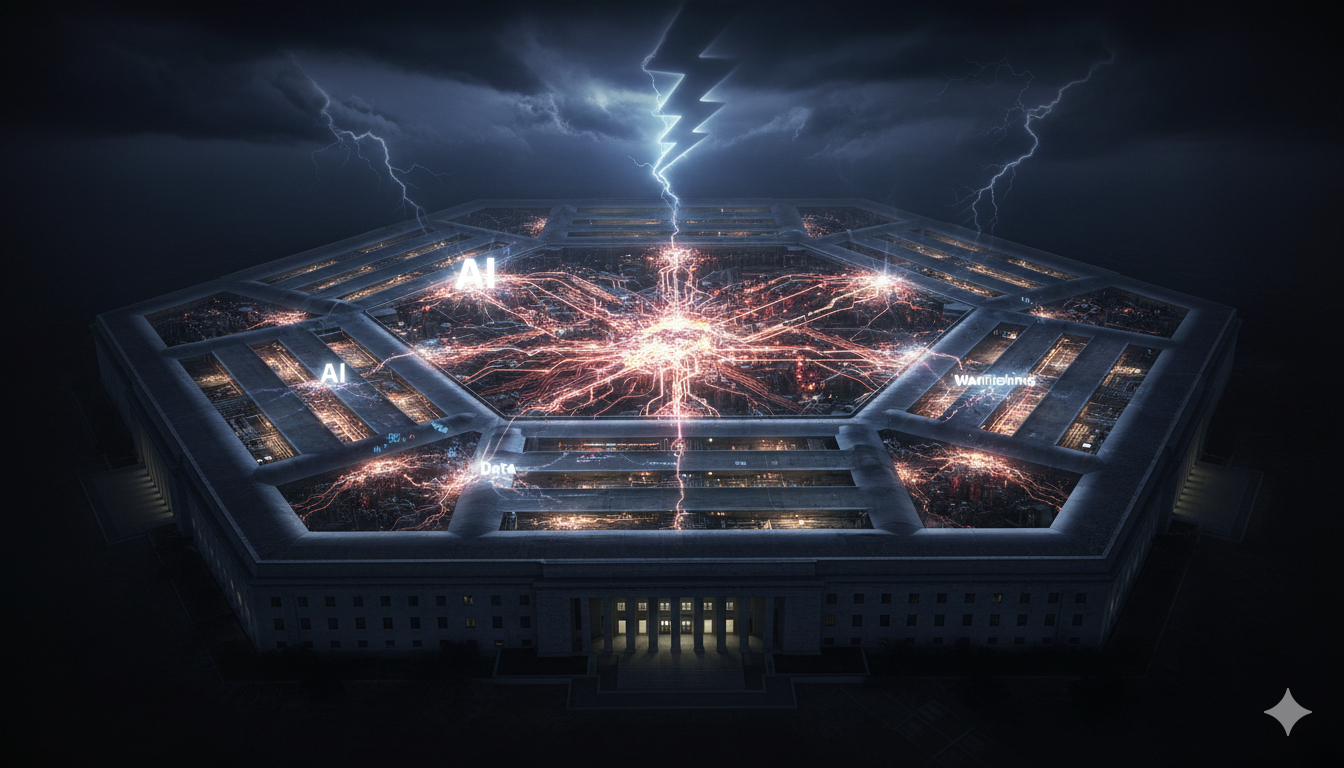
behind the sparkling distractions, things are moving
I don’t know about you, but in the arch from Ukraine to Israel, the Red Sea, and Venezuela to the First Island Chain (OK, that is less of an arc than a Nike Swoosh), it is getting hard to keep up on the natsec front.
It is fun, and exciting, to keep track of the flashing objects—it is real, you can see it, and it is what we are most comfortable with.
If you are looking at the long-term, there are the things in the background, the machine inside the skin, that really matter. It has been a busy year, and the new Pentagon team—younger and more vigorous than its predecessor—is moving fast across a whole host of fronts when it comes not just to people, but process, organization, and culture.
It is a challenge to find in open source where some of those currents are, but last week we got a bit of a glimpse of it in the remarks by Secretary or War Pete Hegseth at SpaceX in Starbase, Texas.
The venue is important in understanding the context here: tech, innovation, etc…but in the speech there are some points that I think are helpful if you are trying to get a feeling for some of the ideas bubbling around behind the walls of the Pentagon.
Before we do that, I wanted to put out a marker that I was going to put at the end, but I think it is better to bring this up front.
I had already been a LCDR for a couple of years when Donald Rumsfeld became Secretary of Defense. Of the many things he was known for, even before the attacks of 09/11/2001, was his commitment to, sigh, transformation.
Rumsfeld announced his commitment to a revolution in military affairs in his 2001 confirmation hearing before the Senate Armed Services Committee. In a harbinger of rhetoric to come, he not only refused to rule out another round of military base closings, but he also announced his intention to reform the military acquisition process, which he declared ill-suited “to meet the demands posed by an expansion of unconventional and asymmetrical threats in an era of rapid technological advances.”
As we discussed yesterday, in part, especially in the Navy—the results were not that great. It sure did transform the Navy, but not in a positive way.
Of course, in 2025, everyone is aware of where the hubris, hand-waving away of program and technology risk got us, but we’ve seen this mindset before. It is a laudatory approach, but it is not as easy as it seems.
The future is not written, and nothing is predestined, but this is a road that is well-rutted. As long as we are aware of that, there is a reason to be optimistic.
With that caveat on the table, let’s dive in.
…Simply put, the United States must win the strategic competition for 21st century technological supremacy. Artificial intelligence, autonomous systems, quantum, hypersonics and long range drones:
That is a goal, not unlike in the 1930s, the nation that mastered radar, sonar, submarines, and aircraft would dominate the next war.
He then dives into something we have discussed many times here over the last two decades—the accretion encrusted, archaic bureaucratic acquisition system we have allowed to envelop the Pentagon, like so many barnacles, since the Cold War.
…this system provided us with the weapons that won the Cold War, it is archaic and inconsistent with the novel threat environment that we face today. At its core, this old approach has the hubris to assume that you can easily predict the future, that you can foresee how an invention becomes a weapon in eight easy steps three decades from first discovery.
…the department’s process for fielding new capabilities had become just one more post-Cold War peace dividend relic that has not kept up with the times.
Worse than that, we’ve done nothing but add layer upon layer of committees and councils that coordinated but never decided. We created endless projects with no accountable owners. We have high churn with little progress and few outputs.
Well, long-standing members of the Front Porch, what can we say? That paraphrases much of what we have talked about here and on the Midrats Podcast for a very long time. No one likes a kiss-ass, but it would be rude to do anything more than say, “Amen.”
Even if you don’t like Hegseth or DJT, you have to give them a nod.
We can no longer afford to wait a decade for our legacy prime contractors to deliver the next perfect system only to find that it’s delivered years behind schedule and cost ten times what it should. Winning requires a new playbook.
He is being too kind…at least in the Surface Navy and to a lesser degree TACAIR, we have lost an entire generation due to the failures of the Age of Transformation™.
Again, remember the venue here—the emphasis is on the technical side of the house, but it appears this will bleed over into all areas, even some that it will not fit well—which I will mention later on.
Let’s see who the players are.
…our Undersecretary of War for Research and Engineering, Emil Michael right here in the front row, is the War Department’s single chief technology officer. One CTO for the entire enterprise, novel concept.
As the sole CTO, Emil will set the technical direction, lead the innovation ecosystem that will welcome progress from anywhere it resides. And he’ll tell me face-to-face every day,
That helps with accountability. If you are not familiar with him, click the hypertext on his name above.
Accountability is something that we did not see in the compounding failures in the Age of Transformation, but in this speech, it keeps coming up.
The catalyst for this acceleration will be seven pacesetting projects focused on mission threads across warfighting, intelligence and enterprise missions, each with a single accountable leader, aggressive timelines and measurable outcomes that answer a familiar question, Elon: what have you accomplished this week?
This is the execution standard for AI first transformation. Each of the seven pacesetting projects will use the following model: one owner who reports monthly on their progress. These projects will not be run in a vacuum but will work directly with warfighters and transition partners to ensure we incorporate real time operational feedback.
In some ways, this looks like an accelerated version of Meyer’s, “Build a little, test a little, learn a lot.”
That’s why we will run continuous experimentation campaigns, quarterly force on force combat labs with AI coordinated swarms, agent-based cyber defense and distributed command and control, pushing the envelope, learning from failure at every stop, which is exactly what this place does. …And we’re proud to announce that Mr. Cameron Stanley has been appointed the new Chief Digital and Artificial Intelligence Officer, CDAO of our War Department.
We also have six new rules. I still feel a little bit of Rumsfeld here…but that may just be my motor memory.
- Speed: “…Cam and his team at TD — at CDAO will define AI deployment velocity metrics for all the pacesetting projects in the next 30 days and report at least monthly after that. These will become the new benchmarks for programs across the department.“
- Bureaucratic blockers: “…I’m establishing a barrier removal SWAT team under R&E with the authority to waive non-statutory requirements and escalate to our great deputy secretary, Steve Feinberg, anything that slows down the acceleration of AI capabilities.“ Yes, yes yes, I remember. I was on a Barrier Removal Team while on staff in the mid-00s. Yes, yes, I know.
- Compute resource: “…President Trump’s executive order has directed us to build data centers on military land and to work with the Department of Energy to ensure that we dramatically increase the number and breadth of resources needed to power this computing infrastructure.“
- Talent: “We will use every hiring and pay authority available to us to bring the best American technical talent and reward effective AI transformations by our workforce.“
- Responsible AI: “…equitable AI and other DEI and social justice infusions that constrain and confuse our employment of this technology. Effective immediately, responsible AI at the War Department means objectively truthful AI capabilities employed securely and within the laws governing the activities of the department. We will not employ AI models that won’t allow you to fight wars.
We will judge AI models on this standard alone; factually accurate, mission relevant, without ideological constraints that limit lawful military applications.“ Wait…what? Someone needs to brief me on what was created that required a pushback against a “woke” and “social justice” AI. There is a backstory here I need to see.
- Data: “…the US military has an asymmetric data advantage from two decades of military and intelligence operations that no other military in the world can replicate.“
That last bullet—that is what AI is best at, chewing on a mass of data to produce usable information in a tidy package.
There is another gem that demands a backstory, “data hoarding?”
Too much of our data is stranded. It’s stuck in bespoke program databases locked behind Title 10 or Title 50 stovepipes, …
AI is only as good as the data that it receives, and we’re going to make sure that it’s there.
Persistent barriers to data access will be escalated to the deputy secretary of war for resolution, with authority to reassign or terminate personnel or withhold funding from non-compliant activities within the statutory limits. We’ll be clear here. As I said, data hoarding is now a national security risk, and we will treat it that way.
As long as that data does not include a lot on U.S. citizens, I’m OK with that. If it does, send it to DOJ.
We change gears here rather abruptly into an area I’m very glad to see addressed.
