

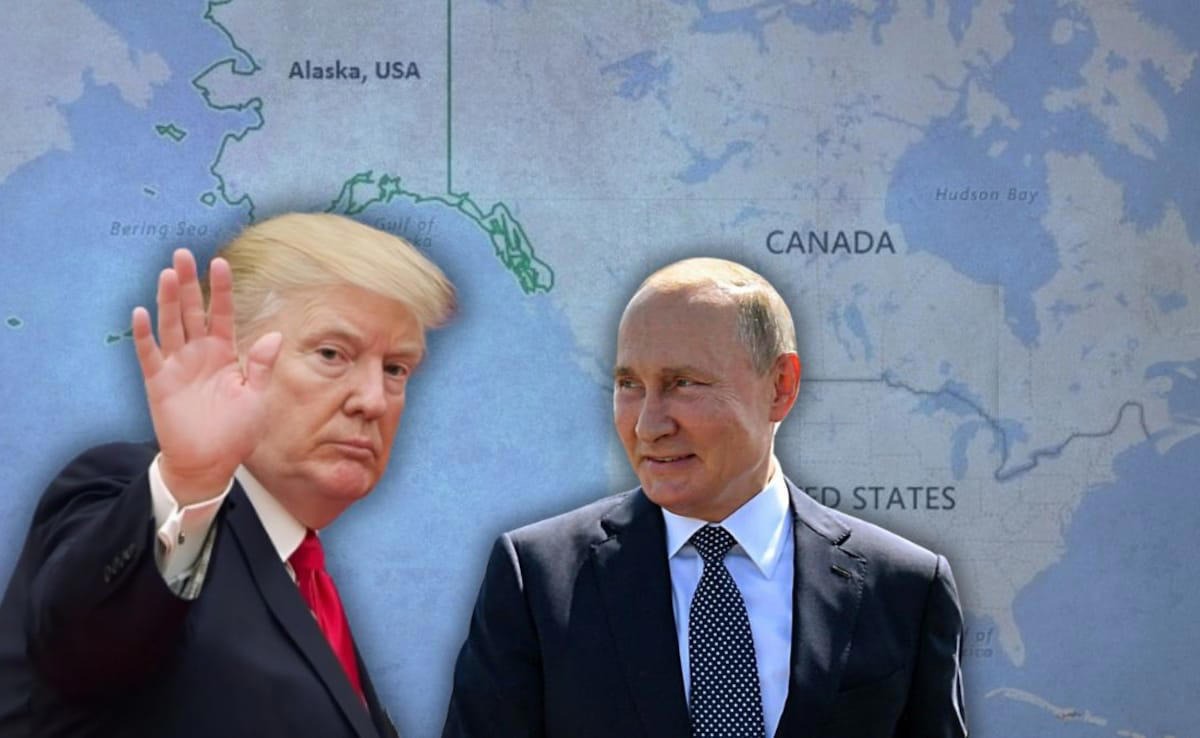
Speaking of things that took Trump’s enemies completely by surprise this week. The New York Times ran a prophetic but uninformative top-of-page story yesterday headlined, “When Trump Meets Putin, Anything Could Happen.” No duh. Thanks for that newsflash. But it really means they have no idea what’s going to happen.
That headline translated to: ‘We’ve got bupkis, folks. Zip. Nada.’ No leaks. No rumors. Not even a tremulous anonymous source offering to swap secrets for an NPR tote bag. And if that left the media’s right eye twitching, it was nothing compared to the Europeans, who are currently mainlining espresso and chewing the lacquer off their manicured fingernails. It’s practically existential dread.
In a galactic level of irony and happenstance, the Times picked this particular picture to lead its story (shown above). It depicts one of the last times Trump and Putin met face-to-face. The fateful meeting in 2018, in Helsinki. The star-crossed meeting wherein I strongly suspect Putin handed Trump what we now know he had —a 2016 Russian intelligence report laying out Hillary Clinton’s RussiaGate plot— and which U.S. intelligence failed to provide their own President even though they’d had a copy for nearly two years.
Behold how suggestively the Times captioned its photo: “President Trump sided with President Vladimir V. Putin of Russia on whether the Kremlin had meddled in the 2016 U.S. election during their meeting in Helsinki in 2018.”
That caption makes me think that, after all this recent declassification, the Times knows that Trump and Putin have a lot of very interesting threads to pick up.
Now, Trump and Putin are meeting again, completing a seven-year arc through two impeachments, four years in the prosecutorial wilderness, the entire Proxy War, and Trump’s triumphant return to power. As they said, anything could happen.
The Times story provided some more context than we’d had before. Helsinki was not the first time Trump and Putin spoke privately. The first private encounter was in 2017— one year after Russia tried to alert the Obama intelligence agencies about Hillary’s plot:
When the men first sat down together, at a Group of 20 summit in Hamburg, Germany, in 2017, Mr. Trump was joined only by his secretary of state, Rex Tillerson, and an interpreter. After the meeting, Mr. Trump took the interpreter’s notes and ordered him not to disclose what he heard.
That evening, Mr. Trump and Mr. Putin had an impromptu conversation, initiated by Mr. Trump, at a group dinner. No other Americans were present, and the White House confirmed the meeting only after surprised witnesses spoke to reporters.
Asked by reporters what he had told Mr. Trump in Hamburg about the 2016 election, Mr. Putin replied, “I got the impression that my answers satisfied him.”
That new context could explain a lot, more than I have time to get into this morning. But remember it for later.
The new meeting, the first since Trump 1.0, is set for Friday in remote Alaska— where privacy is guaranteed. Last Friday’s announcement took the media, the Ukrainians, and the Europeans by complete surprise. It’s fair to say they are terrified. The Guardian, this morning:

Politico, European Edition, yesterday:

Europe fears betrayal! Maybe not all of Europe, but their leaders are right to fear it. They helped Zelensky create the impeachment case against Trump seven years ago.
Speaking for the U.S. on today’s ‘frantic’ call will be: President Trump and Vice-President Vance. That’s the whole list. Attending the totally lopsided call for the ‘affected parties’ will be an astonishing list of narcissistic European neocons and one unamusing former comedian: Friedrich Merz (Germany), Alexander Stubb (Finland), Emmanuel Macron (Frogs), Giorgia Meloni* (Italy), Donald Tusk (Poland), Keir Starmer (UK), Ursula von der Leyen (E.U.), António Costa (ditto), Mark Rutte (NATO), and last and least, tiny Volodymyr Zelenskyy (two y’s). Whew. (* Actually, I kind of like Giorgia Meloni. But she’s the only one.)
To call these Defenders of Democracy’s ringleader Friedrich Merz “insufferable” does violence to that label. The worm-like leader’s internal popularity in Germany currently swirls the toilet bowl at an astonishing 24%—within his own party. Britain’s Kier Starmer is competing for worst, with a rock-bottom 23% favorable rating. Rounding out the big three is dainty Emmanuel Macron, for whom only 26% of Frenchmen hold any affection.
Just imagine how harshly the media would handle a U.S. president with a 23% popularity rating. “Rejected by voters!” “No mandate!” “Legitimacy crisis!” But they still treat these jokers as serious leaders. It’s a good bet that Trump knows better.
And honestly, there should be an upper limit to the number of people who can participate in one phone call. Group Zooms are bad enough. Have some sympathy for our hardworking president and vice-president, whose calendars include enduring a very painful gripe session today.
Anyway, yesterday, I heard a theory —a simple, fact-based theory I’d overlooked— connecting even more delicious dots. Till I heard it, I’d only expected that Trump would announce progress, but figured he would just push the timeline back another couple months and give the Russians a little more breathing room.
But this new theory changed my mind. Now I think something enormous could be coming together.
Robert Barnes is an American litigator and another veteran of the pandemic legal wars. He often pops up on podcasts and offers insightful commentary about current events. Like me, Robert has lots of opinions, and usually smart ones. Unsurprisingly, we are usually aligned. Like me, Barnes is fascinated by the timing of all these Trump events, and he agrees the timeline is probably not coincidental.
On a podcast Monday, Robert pointed out the remarkable and absolutely correct fact that, until Tulsi Gabbard began declassifying RussiaGate evidence, Trump was still stymied under a black “Russian influence” cloud.
No matter what he did to settle the war, if he gave any concessions to Putin, no matter how reasonable or justified, his enemies would have instantly accused him of “selling out” to Russia. They’d have hung him higher than Haman, with the rope of Russia collusion.
Barnes is right. Trump was stuck. It was like a hostage situation; his enemies were still holding Russia Collusion at a secret location, to force Trump to stay in his lane. Then, a few weeks ago, Trump sent in a rhetorical special forces team and started declassifying documents, one after another.
Now, everything has changed.
Within a handful of weeks, all Trump’s enemies have now lawyered up. And their lawyers have surely told them to shut up. Anyone who now accuses Trump of being compromised by Russia risks being linked to the seditious plot.
In other words, it had to happen in this order. Trump had to draw out the poison. First declass, then peace deals. In hindsight, it seems obvious that Trump could never settle the proxy war with Putin until after he’d briefed the public on where the RussiaGate allegations originally came from.
The mind-blowing implication is that this sudden and unexpected meeting between Trump and Putin was not a happy recent accident, but was planned long ago, before the declassifications began.
And if that is the case, then whatever the two leaders plan to do has also been long in the works. And if that is true, then it may not, as I thought and many others suggested, be a dud of a meeting where they only ‘make progress’ but don’t agree on anything.
Instead, it could be something historic. Maybe ending the Proxy War. Maybe something even bigger than that.
I know we are all hoping for high-profile arrests, but … could whatever deal Trump is planning to announce at this meeting explain why DC is now under federal control? The synchronicity is very suggestive. Whatever he’s planning in Alaska could create a global shock wave of NGO-fueled progressive protest. (It could also include arrests, who knows? That’s the point; nobody but Trump’s Team knows. Isn’t it exciting?)
Or maybe it’s all just random noise, incoherent political signals with no discernable tune. First, Tulsi Gabbard starts dropping the RussiaGate receipts, scrubbing the “Russian asset” smear off Trump like it was last season’s graffiti. Then — totally unrelated — the capital gets locked down under a leak-proof, multi-agency security blanket, with the National Guard on street corners and Pam Bondi running the cops.
And finally — pure happenstance — Trump pops up in richly symbolic Alaska, for his first closed-door confab with Putin since 2018. If you believe in Jungian synchronicity, that’s the classic trifecta: the Clearing of the Shadow, the Guarding of the Threshold, and the Meeting in the Borderlands. Or, if you don’t, then it’s just three consecutive, airtight, symbolically aligned moves in the span of a week, all pointing in the same direction for no reason whatsoever. Either way.
Among other advantages, Borderland Alaska was clearly selected because it is remote. Reporters (and party-crashing former comedians) wanting to infest the meeting will need snowshoes and rented dogsleds. Last night, the Times confirmed America will host the historic meeting at the even more secure and inaccessible Joint Base Elmendorf–Richardson in Anchorage. It is not unprecedented: In 1971, Nixon hosted Japan’s Emperor Hirohito at JBER.
Hosting the meeting at JBER means no photos, no leaks, no running commentary, no hotel staff interviews, nothing. It’s a total blackout. We’ll all just have to wait for the official announcement. The location itself might not be unprecedented, but the complete absence of any signal, speculation, or hint of what might be coming is, in living memory, unheard of.
The closest historical analogue might be 1945’s Yalta Conference between Stalin, Churchill, and FDR, held in remote Crimea. In a twist for the history books, Crimea is also now one of the Ukrainian territories at the heart of the current conflict. Talk about historical bookends.
As the Times said in its headline, “Anything could happen.” And they’re right. They can see something is coming, too — they just hate being in the same position as the rest of us: outside the loop, staring at a sealed box, waiting for it to open.

Putin has always wanted to be trading partner with the US and the limited restraint he has shown is because of Trump diplomatic integrity. The EU (Minsk) on the other hand, Putin couldn’t care less!