

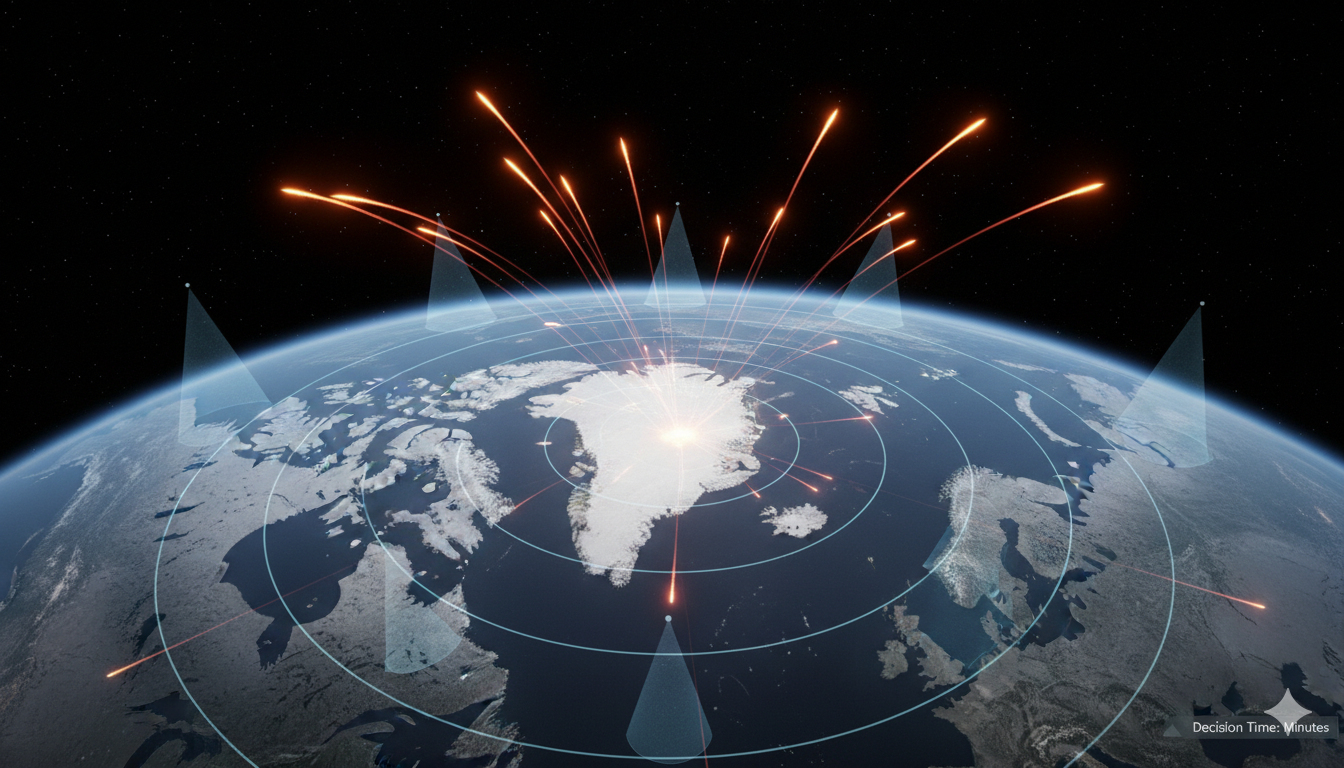
Donald Trump’s determination to bring Greenland under American control has been widely mocked as eccentric or theatrical.
That reaction misses the point.
Beneath the blunt language and headline-grabbing delivery lies a strategic argument rooted in geography, military physics, alliance realities, and the accelerating competition among global powers in the Arctic. Trump’s fixation on Greenland is not a whim. It is the product of a long-running belief that the island represents one of the most valuable pieces of territory on Earth for American security.
Failing to secure it would amount to a historic act of negligence.
Trump’s public interest in Greenland first emerged in August 2019, when reports revealed that he had privately asked advisers about purchasing the island from Denmark. He confirmed the interest himself, describing Greenland as strategically interesting and emphasizing the close alliance between the United States and Denmark. At the time, he framed the idea as exploratory rather than urgent, noting that it was not the top priority on his agenda.
Yet even then, the logic was clear. The United States already provided extensive military protection to Denmark. Meanwhile, Greenland sat at the crossroads of American, European, and Arctic security.
Trump also raised an economic argument during that period, claiming that Denmark was losing roughly 700 million dollars annually subsidizing Greenland. This reflected Trump’s broader view that the status quo was inefficient. In his telling, a U.S. purchase would relieve Denmark of a financial burden while placing the island under the protection of a military superpower capable of fully defending it.
He famously described the idea as a large real estate deal, a phrase that drew ridicule but also revealed how he conceptualized statecraft as a transaction grounded in tangible assets.
When Denmark’s government rejected the idea outright, Trump responded by postponing a planned state visit, explicitly citing Prime Minister Mette Frederiksen’s refusal to discuss a sale. The episode demonstrated that this was not a casual suggestion. Trump was willing to incur diplomatic friction to signal that Greenland mattered.
After several years of relative quiet, the issue returned with force in late 2024. As president-elect, Trump declared that ownership and control of Greenland were an absolute necessity not just for America’s national security, but freedom throughout the world. This was a marked escalation. Greenland was no longer merely interesting. It was essential.
By 2025, Trump’s rhetoric sharpened further.
Addressing Greenlanders ahead of their parliamentary elections, he publicly supported their right to determine their own future while inviting them to join the United States, promising safety and prosperity if they did so. In the same period, he stated bluntly that Greenland was needed for international security and that the United States was going to get it one way or the other.
The language was intentionally stark, conveying inevitability rather than negotiation.
The urgency intensified in January 2026, when Trump issued a series of statements tying Greenland directly to what he described as the Golden Dome, a next-generation missile defense system under development. He asserted that Greenland was vital to the system’s effectiveness and warned that if the United States did not secure the island, Russia or China would. He argued that NATO’s deterrent power depended overwhelmingly on American military strength and that NATO would become far more formidable with Greenland in U.S. hands.
Trump followed this with an even more aggressive declaration days later.
He accused Denmark and multiple European countries of creating a dangerous situation in Greenland. Then he announced escalating tariffs unless negotiations began for the complete purchase of the island. He stated that the United States had sought to acquire Greenland for more than 150 years and that modern weapons systems made acquisition especially urgent.
Trump also said that hundreds of billions of dollars were being spent on security programs related to the Golden Dome and that the system’s geometry required Greenland’s inclusion to function at maximum efficiency.
This focus on geometry is central to his argument and often overlooked.
Missile defense is not simply about technology. It is about angles, distances, trajectories, and early warning time. Attacks launched over the polar region reach North America faster and with less warning than those from other directions. Greenland’s location makes it uniquely valuable for radar coverage, space surveillance, and interception paths. Trump has argued repeatedly that leases or temporary basing agreements are insufficient for such a mission.
Speaking to reporters, he stated that countries defend ownership, not leases, and that Greenland would have to be defended as sovereign U.S. territory. He dismissed long-term lease arrangements as inherently unreliable.
Trump has also been explicit about adversaries.
He has said that while he respects the people of China and Russia, he does not want them as neighbors in Greenland and expects NATO to understand that reality.

I really don’t think there is any reason to oppose this other than “Trump wants it, so we oppose it.” The necessity is clear to see.
You are right, they have done everything to stop the peace in lost cause Ukraine too.
Interesting there isnt enough slave labor in all of Greenland available for China to exploit the REM mining. According to climate experts it may be at least 10 years before orange plantations can be viable ;).
We will see a bit of Greenland climate here the next few days, 45 below with WCF, open any cabinets that have plumbing an an outside wall, run a trickle of cold water to keep the lines from freezing and brace for the next gas bill.
We, too, will be seeing a bit of the climate that we’ve been told is long gone.
Ice storms the fricken worst, I hope everyone is prepared this time for the power outages. They are now burying the power lines near camp they tire of trees falling on them all the time.
And no one south of illunois seems to know anything about snow removal or winter driving.
Well, it’s 54 here now. Tomorrow, it’s supposed to start raining at 8am at 49 and the temp dropping from there. In 2020, we had had below freezing temps for a week before we had the snow, so ALL of it stuck. Then, it got COLDER, eventually below zero. I don’t see that this time.
Forcast…