

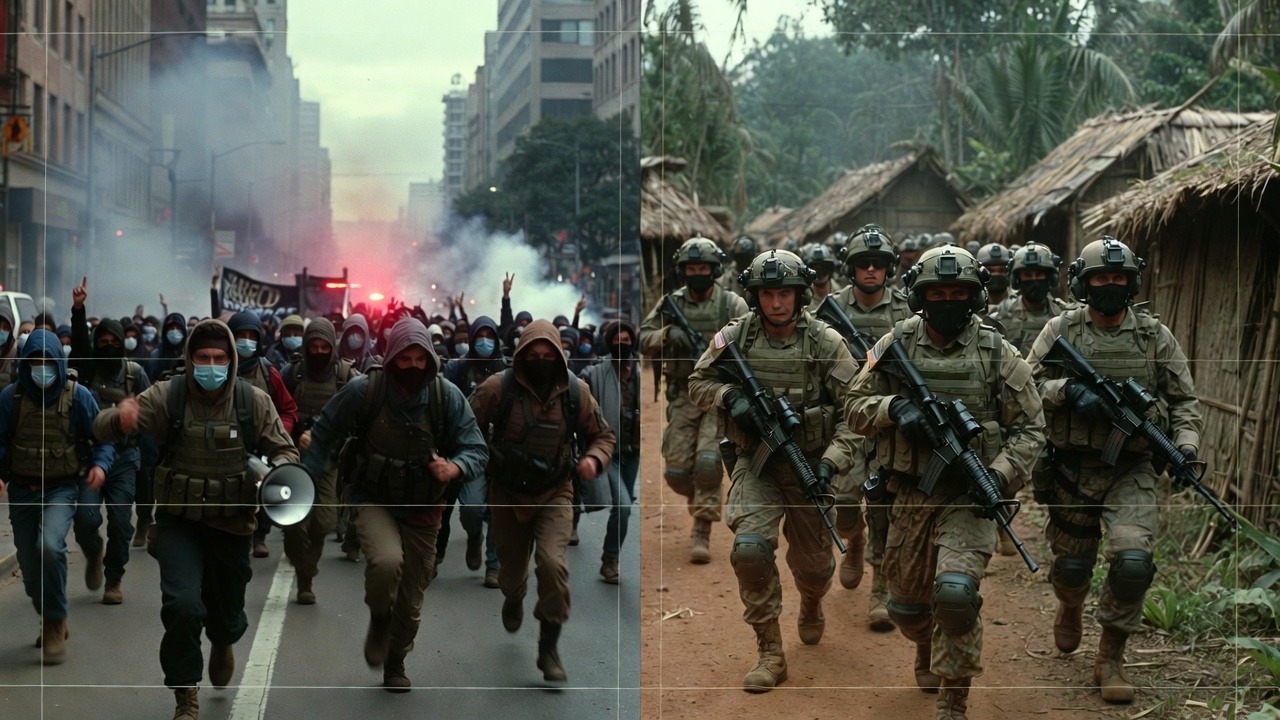
I know many of you are asking: what could a scrappy street protest have in common with a clandestine guerrilla campaign? At first glance, the worlds of grassroots activists and U.S. Army Special Forces couldn’t seem further apart. One fights with placards and flash mobs; the other with clandestine raids and military training.
Yet the activist manual Beautiful Trouble—a creative toolbox for civil resistance—contains tactics and principles that closely echo the doctrine of Special Forces (SF) Unconventional Warfare (UW). Both playbooks, in their own way, explore how a smaller, unconventional force can challenge a powerful establishment by mobilizing people, shaping narratives, and forcing the opponent into tough choices.
This article takes an accessible look at how Beautiful Trouble’s protest tactics align with (or diverge from) U.S. SF UW doctrine, using real world examples from the Arab Spring to Occupy Wall Street to illustrate the surprising parallels. In doing so, we’ll see how understanding activist “tricks of the trade” can shed light on modern resistance movements and the murky battlefields of today’s gray zone conflicts.
Unconventional Warfare 101: The Green Beret Playbook
In U.S. military doctrine, UW refers to campaigns where special forces work by, with, and through local resistance groups to topple a government or expel an occupier without deploying large conventional armies. The classic UW mission is for a small SF team (also known as Green Berets) to secretly aid an underground insurgency—arming and training guerrillas, conducting sabotage and subversion, and coordinating propaganda—all to weaken an adversary from within.
Doctrinally, a U.S. sponsored insurgency is described as progressing through seven phases: Preparation, Initial Contact, Infiltration, Organization, Buildup, Employment, and Transition. Each phase lays groundwork for the next, though in practice they may overlap or loop back as needed.
- Preparation: Long before any fighting starts, UW emphasizes shaping the environment. SF and allied agencies conduct deep analysis of the target society—studying its politics, grievances, and power centers—and begin psychological operations to sway hearts and minds. This can include everything from spreading white propaganda (overt information campaigns) to covert black propaganda that masquerades as local dissent. The goal is to create a climate where the population is sympathetic to the resistance cause. For example, in the lead up to the 2001 Afghanistan campaign, U.S. operatives established contacts with anti-Taliban factions and subtly prepared the narrative of liberation before boots ever hit the ground. In UW terms, preparation is all about setting the stage politically and psychologically so that an uprising will find fertile soil.
- Initial Contact: Once the groundwork is laid, secret outreach begins. Special Forces or CIA operatives make clandestine contact with key local leaders or disaffected military officers in the target region. They assess the resistance potential and gain trust, essentially saying: “We’re ready to help you, if you’re willing to act.” A historical example: in World War II, Allied agents quietly linked up with French Resistance cells months before D-Day, offering support and coordinating plans. Initial contact is delicate—a feeling out phase where a wrong move could blow the whole operation. But if successful, it paves the way for boots on the ground.
- Infiltration: With local allies awaiting, UW teams slip into the area of operations in secret. Green Berets might parachute in by night, cross borders posing as civilians, or use submarines to land on a hostile shore—whatever it takes to get a handful of advisers inside the denied area without alerting the authorities. These operatives often carry little more than radios, survival gear, and a head full of the best training in the world. Once in place, they link up with the underground. In this phase, operational security is paramount: communication is minimized or encrypted, meetings are covert, and recruits are vetted, since a single informant could betray the nascent rebellion. In modern UW, the infiltrators also help the locals set up secure channels (couriers, secret signals) to outfox the regime’s surveillance.
- Organization: Now the real work of building a resistance army begins. SF helps organize the guerrilla fighters, an underground network, and an auxiliary support system—often in a clandestine cell structure. Think of this as establishing the “shadow” organization that will contest the state’s power. Villagers might be trained as part time militia; urban sympathizers form cells to gather intelligence or shelter fugitives; friendly locals become couriers and medics. Weapons, supplies, and training are distributed according to roles. In parallel, leaders are mentored: a charismatic rebel commander might learn about battle tactics and also how to run a stable civil administration in liberated areas. This phase is essentially movement building—turning a disorganized grievance into a capable force. By the end of Organization, the insurgency has a structure: combat units, secret supporters, and a leadership ready to expand the fight.
- Buildup: Armed with structure and confidence, the resistance shifts from hiding to hitting. The Buildup phase involves escalating pressure through low risk, high reward actions. In UW doctrine, this often means guerrilla attacks: ambushes, raids, sabotage of infrastructure, or dissemination of subversive propaganda—all aimed at eroding the enemy’s strength without yet provoking full scale battle. A bridge might mysteriously blow up (sabotage) or a local official disappears (covert action) as the insurgents test the regime’s responses. Importantly, these actions are chosen to build momentum: each success can inspire more recruits and demonstrate the regime’s vulnerability. For instance, the French Resistance blowing railway lines not only slowed Nazi logistics but also proved that resistance was possible, spurring more locals to join. By the end of Buildup, a tipping point is approaching—the movement has grown in numbers, armament, and daring, setting the stage for a decisive confrontation.
- Employment (Combat Operations): This is the climax—the resistance goes fully on the offensive. In UW, the Employment phase means major combat or coordinated uprisings designed to topple the target government or expel occupiers. Guerrilla forces intensify attacks, seize territory, or link up with conventional friendly forces if available. A historical example is the “general uprising” in coordination with a conventional invasion: during WWII, as Allied armies landed in France, Resistance fighters simultaneously sabotaged German defenses and even engaged in pitched battles to liberate towns. In other cases, Employment might be a sustained guerrilla campaign that gradually forces the regime’s collapse (as happened with the Viet Cong insurgency). The key is that by this phase, the insurgents have transformed from rag tag rebels to a formidable force openly challenging the enemy. It’s high risk, high reward—the moment of truth where unconventional war becomes very conventional in its intensity.
- Transition: If all goes well, the regime falls or gives up, and the once “unconventional” warriors suddenly find themselves in charge. What now? UW doctrine stresses that after victory, transition is critical. Guerrillas may need to demobilize or integrate into a new national army; political wings of the movement might form a new government. SF advisors, if still on the ground, help shift from fighting to stabilizing. The doctrine pointedly notes that the guerrilla force must support the new authorities rather than splinter into warlordism. For instance, after aiding resistance fighters, U.S. advisors might assist them in securing key infrastructure and preventing chaos in the immediate aftermath of success. One can think of post revolution scenarios: in 2003 Iraq, lack of planning for the “day after” led to chaos—a lesson for why Transition planning matters. The ultimate goal is a stable environment where former rebels become the legitimate security forces or peaceful citizens, and external sponsors quietly step back.
In summary, UW is a patient art. It might take years from the first whispered contact to the final victory parade. Throughout, it harnesses not just brute force but political, psychological, and informational strategies—essentially, mobilizing people and ideas as weapons. And this is exactly where an activist playbook like Beautiful Trouble starts to resonate.
Beautiful Trouble: A Field Manual for Creative Disruption
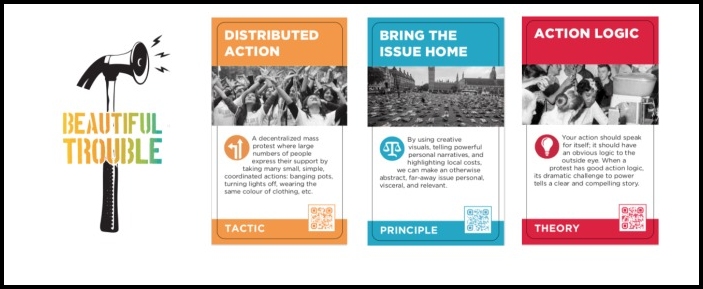
Beautiful Trouble is often described as a toolbox for creative activism, and for good reason. Developed by dozens of veteran organizers and artists, it “lays out the core tactics, principles and theoretical concepts that drive creative activism” in an easily digestible format. In place of military procedures, it offers activist tactics—like flash mobs, blockades, or media jacking—and organizing principles like “put your target in a decision dilemma” or “know your cultural terrain.”
Each entry in the manual is a bite sized lesson drawn from real world campaigns, complete with case studies of protests or pranks that worked. In effect, Beautiful Trouble is to grassroots movements what a field manual is to soldiers: a compilation of hard won knowledge on how to fight and win—only the battlefield is the public sphere, and the weapons are ideas, images, and people.
The tone of Beautiful Trouble is imaginative and often fun (for lack of a better term), reflecting the culture of activism. You’ll find sections on creative pranks (like impersonating a CEO at a press conference), guides to direct action (physically intervening to stop an injustice), and notes on strategy (how to choose targets or tell a compelling story).
Underlying the playful vibe is a serious aim: to drive change by causing well planned trouble. As the editors put it, art and mischief can have real world impact if deployed thoughtfully:
“Pranks, stunts, flash mobs and encampments can bring about real shifts in the balance of power” when done correctly.
One key aspect of the manual is how it links tactics to principles. For example, the tactic of a blockade (physically obstructing a road, building, or pipeline) is linked to principles like “make your actions both concrete and communicative”. In other words, a blockade should not only concretely stop something from happening, but also communicate a message through its symbolism. If you form a human chain across a roadway, you might literally halt business as usual and create a potent image of resistance.
Beautiful Trouble emphasizes this blend of the practical and the symbolic in many of its entries.
Another example: the principle “put your target in a decision dilemma”. This concept, which we’ll explore more later, advises activists to design actions that force those in power into a no win situation. A classic scenario is a peaceful protest that blocks a crucial doorway: if the authorities do nothing, the disruption succeeds; if they crack down harshly, they look like villains and spur public sympathy for the protesters. As we’ll see, that idea has a direct parallel in how guerrilla warfare seeks to undermine an opponent’s legitimacy.
Overall, Beautiful Trouble serves as a repository of “people power” tactics. Much like UW doctrine, it acknowledges that effective resistance is part material and part psychological. Yes, activists lack tanks or billions of dollars, but with smart strategy they can leverage creativity, numbers, and moral authority to punch far above their weight.
The manual’s very first principle is telling: “Anger works best when you have the moral high ground.” The moral high ground is an activist’s equivalent of the high ground on a battlefield—a position of strength. Through the lens of Beautiful Trouble, we can analyze how non state actors (from pro-democracy students to anti-corporate agitators) mobilize political pressure, wage psychological contests, and exploit information channels to achieve their goals. Now, let’s put these two frameworks side by side—the insurgent’s roadmap and the activist’s playbook—to see where they coincide.
